The 5 Best Laminators for Homeschool Families - And the One I Actually Bought
- HumbleHomeschoolerMama
- Jun 28
- 9 min read
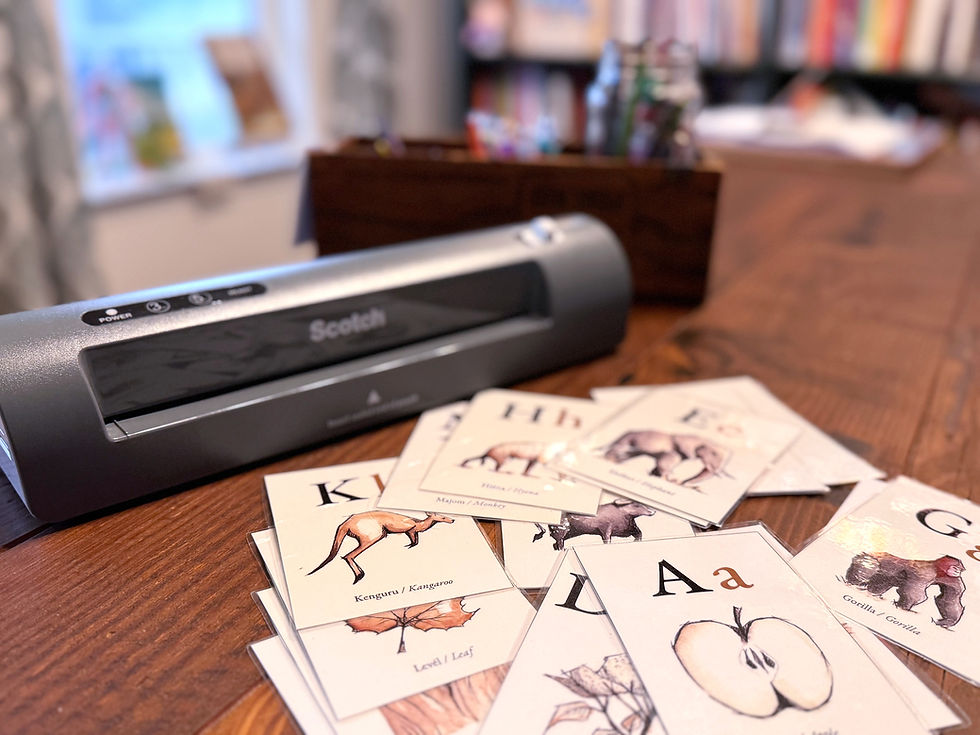
I didn't think I needed a laminator until the third time I watched a beautifully made set of phonics cards get destroyed by a juice spill, a dog, and three years of small, sticky hands.
That was the moment I finally gave in and bought one. And I'll be honest — I expected it to be one of those purchases that sits in a closet after the first use. Instead, it's become one of the most-used tools in our entire homeschool, right up there with our printer.
Flashcards that actually survive. Morning basket cards that don't get torn on day two. Chore charts, name cards, nomenclature cards, math fact strips, schedule cards — all of it lasts for years instead of weeks once it's sealed in plastic.
If you've ever rewritten the same set of sight words for the third time because the originals got destroyed, you already know exactly why this tool matters. A good laminator isn't a "nice extra" in a homeschool — it's the difference between making materials once and making them over and over again.
I tried a couple of cheaper options before landing on the one I now genuinely recommend to every homeschool friend who asks. Below is the full lineup — five real, Amazon-available laminators, organized by what kind of homeschool printing life you actually have, plus the one I bought and still use today.
A quick, honest note before we dive in: this post contains affiliate links. If you click through and make a purchase, I may earn a small commission at no extra cost to you. I only recommend equipment I've genuinely researched or used myself.
What Actually Matters When Choosing a Homeschool Laminator
A few things to weigh before the list, because "best laminator" really does depend on what you're laminating:
Width matters more than people expect. A 9-inch laminator handles letter-size pages, flashcards, and most worksheets just fine. If you regularly laminate posters, large charts, or 11×17 artwork, you'll want a 13-inch (A3-width) model instead.
Warm-up time is the hidden time-cost. Some machines are ready in 60 seconds; others take a full 5 minutes. If you laminate in short pockets of time (nap time, a quiet 15 minutes between subjects), a slow warm-up can eat the whole window before you've laminated a single page.
Jam-release features genuinely matter. Pouches jam. It happens to every laminator eventually. A quick, simple jam-release lever turns an annoyance into a 10-second fix instead of a ruined project and a frustrated afternoon.
Pouches are a separate, ongoing cost. No laminator comes with an unlimited pouch supply — factor in a steady stream of 3 mil pouches (standard for most homeschool use) into your actual long-term cost.
Reliability over years beats flashy features on day one, especially for a tool that's going to get used weekly for a decade of homeschooling.
With that lens, here's the lineup — starting with my own pick, then the best options for other specific needs.
My Top Pick: Scotch Thermal Laminator TL901X

This is the laminator I bought, and the one that's been quietly running our homeschool's "make it once, use it for years" system ever since.
What it is: A compact, 9-inch, two-roller thermal laminator with two heat settings, built for letter-size documents, photos, and flashcards.
The Pros:
Genuinely reliable, proven track record. This model has been a go-to for teachers and homeschoolers for well over a decade, and it shows in the sheer volume of long-term positive reviews — this isn't a trendy gadget, it's a workhorse.
Fast once it's warmed up — it laminates a letter-size page in about a minute, so once you're going, you're really going.
Two-roller system with adjustable heat settings gives a clean, bubble-free, professional finish, and it's safe to use on photos, which matters if you're laminating family keepsakes alongside school materials.
Simple, no-fuss jam release lever — when a pouch does jam, it's a quick fix, not a 20-minute ordeal.
Compact and lightweight, easy to store on a shelf or in a closet between uses.
The Cons:
9 inches wide is its ceiling — it won't handle posters or anything larger than letter-size paper. If big charts and artwork are a regular part of your homeschool, you'll want the wider option below instead.
Warm-up takes about 4–5 minutes, which is average for this category but not the fastest available.
No accessories included beyond the laminator itself — you'll need to buy pouches separately (and budget for an ongoing supply).
Why I recommend it: For the bulk of homeschool laminating — flashcards, worksheets, schedule cards, name tags — this is the simple, reliable tool that just works, year after year, without asking anything extra of you. It's the laminator equivalent of a tool you forget is even a "tool" because it never gives you a reason to think about it.
🧰 If your laminating life is mostly flashcards, worksheets, and letter-size materials, this is genuinely the simplest, most reliable place to start. It's the one I use, two-plus years in. 👉 Check current price on Amazon
Best for Posters & Large Projects: Scotch Thermal Laminator TL1302X (Extra Wide, 13-Inch)
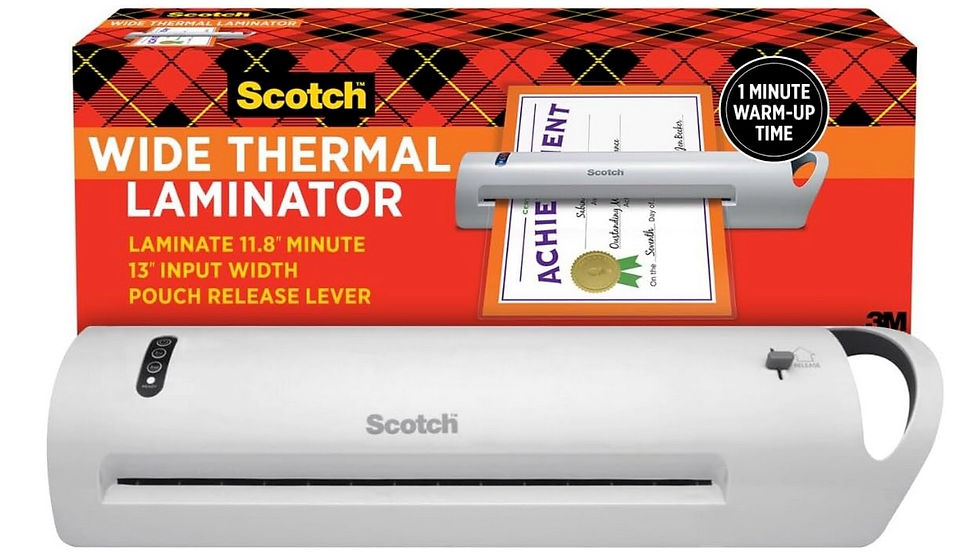
What it is: The wide-format sibling of my top pick — same trusted Scotch reliability, but with a 13-inch (A3-width) feed that handles posters, large charts, and 11×17 paper.
The Pros:
Same dependable Scotch build quality, just scaled up for bigger projects — no trade-off in reliability for the extra width.
Genuinely opens up what you can laminate — large history timelines, science posters, nature-study charts, or oversized artwork no longer need to be trimmed down or pieced together.
Faster warm-up than the standard 9-inch model, typically around a minute, which is a real improvement if you're laminating in short windows.
Trusted brand name for replacement pouches and long-term parts availability.
The Cons:
Bulkier footprint — a 13-inch-wide machine needs more shelf or desk space than the compact 9-inch version.
Costs more upfront than the standard-width Scotch model.
Overkill if you rarely laminate anything bigger than a worksheet — there's no need to pay for width you won't use.
Why I recommend it: If your homeschool regularly produces big, beautiful things worth preserving — a hand-drawn map, a large nature journal page, a poster for a co-op presentation — this is the upgrade that lets you laminate the whole thing in one pass, with the same trusted reliability as my everyday pick.
🗺️ Big projects deserve to actually survive the school year. If posters and large artwork are part of your homeschool routine, this is the size you'll want. 👉 See it on Amazon
Best for No-Wait Laminating: Bonsaii 13-Inch Laminator with Accessory Bundle

What it is: A wide-format 13-inch laminator with a fast warm-up, three heat settings, a built-in jam-release system, and a generous bundle of paper trimmer, corner rounder, and dozens of pouches included.
The Pros:
Fast warm-up — typically ready in 3–4 minutes, which matters enormously if you're squeezing laminating into nap time or a short break between subjects.
Genuinely great accessory bundle — the included paper trimmer and corner rounder mean you're not making a separate purchase just to finish your project cleanly.
Comes with a real stash of starter pouches in multiple sizes (A3, letter, A5, A6), so you can get going immediately without an extra Amazon order.
Three heat settings (3 mil, 5 mil, photo) give you flexibility for different paper weights and photo lamination.
The Cons:
Newer brand than Scotch, so it doesn't have the same decade-plus reliability track record — long-term durability is harder to vouch for with full confidence.
A noticeable plastic smell in the first few uses, which fades but catches some buyers off guard initially.
Bulkier than the compact 9-inch options, simply due to the wider format.
Why I recommend it: If you want everything in one box — the laminator, the trimmer, the corner rounder, and a real pouch supply to get started immediately — this is the most complete, ready-to-go package for a busy homeschool that doesn't want to make three separate purchases before laminating a single thing.
⏱️ If you laminate in short bursts between lessons or during nap time, the fast warm-up and all-in-one accessory bundle here will save you real time. 👉 Check the current price on Amazon
Best Budget Pick: Amazon Basics 9-Inch Thermal Laminator

What it is: A simple, no-frills 9-inch thermal laminator with two heat settings, built for straightforward document and photo lamination.
The Pros:
The most affordable option on this list, making it an easy, low-risk way to add laminating to your homeschool toolkit without a big upfront spend.
Simple to operate — there's nothing complicated here, just plug in, warm up, and laminate.
Compact size fits easily into a small homeschool space or supply closet.
A safe, sensible "try it before you commit" option if you're not yet sure how often you'll actually use a laminator.
The Cons:
Fewer features than the brand-name options — no accessory bundle, no extra heat-setting nuance, nothing beyond the basics.
Less established long-term track record compared to a brand like Scotch that's been in classrooms and homes for years.
Best suited to light, occasional use rather than a daily, heavy-rotation homeschool laminating station.
Why I recommend it: If you're brand new to homeschooling, want to test whether laminating is actually going to become a regular habit, or just need an inexpensive backup machine, this is a sensible, low-cost way to get started.
💸 Not sure yet how much you'll actually laminate? This is the lowest-risk way to find out without a big investment. 👉 See it on Amazon
Best for High-Volume Use: Fellowes Jupiter2 125 Laminator

What it is: A heavy-duty, 12.5-inch laminator from Fellowes — a brand with over a century in the laminating business — built with 6-roller technology and AutoSense pouch-thickness detection for fast, high-volume, professional-grade results.
The Pros:
Trusted, established brand — Fellowes has been a go-to name in offices, schools, and print shops for generations, which matters when you're investing in a higher-priced machine you want to last.
Fast warm-up — ready to laminate in about 60 seconds thanks to Fellowes' InstaHeat technology, so you're not waiting around between projects.
AutoSense technology automatically detects pouch thickness and adjusts settings for you, which takes the guesswork out of switching between different project types.
6-roller system delivers a noticeably smoother, more professional, bubble-free finish, even when running through larger batches.
Built with home and office use in mind — unlike pure commercial-grade machines, Fellowes designs this tier specifically to be reasonable to run in a shared home or office space, not just a noisy back room.
Auto shut-off for safety and energy savings during long homeschool days.
The Cons:
One of the pricier options on this list — a real investment, though it comes from a brand with decades of parts and support behind it.
Larger and heavier than the compact 9-inch options, so it needs a dedicated spot.
More machine than most homeschools actually need — this is built for serious, frequent volume, not occasional flashcard touch-ups.
Why I recommend it: If you're laminating constantly — a large co-op, multiple children's full curriculum sets, or a homeschool that runs like a small classroom — this gives you genuine commercial-grade speed and quality from a name with the long-term reliability track record to back it up, without needing a dedicated noisy back office to run it in.
📚 Running a high-volume homeschool or co-op? This is the machine built to keep pace with serious, daily laminating demands — from a brand that's been doing this for over 100 years. 👉 Check it out on Amazon
Quick Comparison: Which One Is Actually Right for You?
Laminator | Best For | Width | Warm-Up Time |
Everyday flashcards & worksheets | 9" | ~4–5 min | |
Posters & large projects | 13" | ~1 min | |
Fast, all-in-one starter kit | 13" | ~3–4 min | |
Budget / occasional use | 9" | ~4–5 min | |
High-volume, daily laminating | 12.5" | ~1 min |
If you only take one thing from this whole post, let it be this: most homeschools genuinely only need the basic 9-inch model. Don't overspend on width or speed you won't regularly use — start simple, and upgrade later if you find yourself reaching for it constantly.
My Honest Final Take
I almost talked myself out of buying a laminator at all, convinced it would be one more gadget gathering dust. Two-plus years later, the Scotch TL901X has outlasted that worry completely — it's quietly become one of the most-used tools in our homeschool, right behind our printer.
Whichever option you choose from this list, pick based on what you actually make, not what looks impressive in a review. Your flashcards — and your sanity, the next time a juice cup tips over — will thank you.
Disclosure: This post contains affiliate links. As an Amazon Associate, I earn a small commission from qualifying purchases made through these links, at no additional cost to you. The Scotch TL901X is a laminator I personally purchased and use in my own homeschool; all other recommendations are based on thorough research and verified owner feedback.

Comments